
Fish Silage for Cannabis: What the Research Actually Shows
An evidence-based look at fish hydrolysate as a biostimulant input for commercial cannabis production, drawn from peer-reviewed research and real-world agronomy.
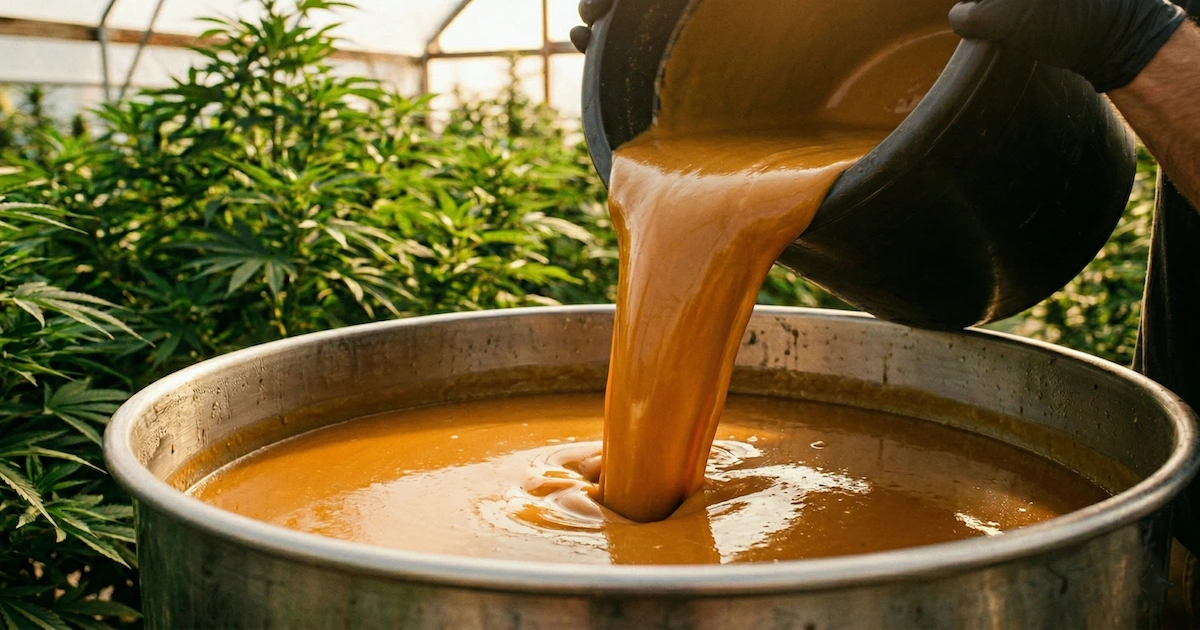
Fish silage is being prepared for application. The amino acids, peptides, and organic nitrogen in this liquid biostimulant drive measurable improvements in root architecture and nutrient uptake.
Fish silage goes by a few names. You will hear it called fish hydrolysate, liquid fish, or fermented fish fertiliser. The product itself is simple: fish processing waste broken down into a liquid rich in amino acids, peptides, organic nitrogen, and trace minerals. What matters to you as a cannabis grower is what those compounds do once they reach your root zone and your leaf surfaces.
The research on fish hydrolysate in cannabis is still young, but it is growing. And what the science shows so far aligns with what experienced organic cultivators have observed for years: this input delivers measurable benefits to root development, nutrient uptake, soil biology, and potentially to terpene and cannabinoid expression.
What Is in Fish Hydrolysate?
Fish hydrolysate is not just another nitrogen source. Its real value lies in its biological complexity. Cold-processed fish hydrolysate retains free amino acids (including lysine, methionine, tryptophan, and cysteine), short-chain peptides, fatty acids, and a spread of micronutrients, including iron, zinc, magnesium, and calcium. The NPK values are modest, generally in the range of 2-4-0 to 2-4-1, depending on the product and fish source, which is low compared to synthetic fertilisers. That is by design. Fish hydrolysate works primarily as a biostimulant, not a standalone fertility source.
Research published in Frontiers in Plant Science (Colla et al., 2014; Ertani et al., 2009) has shown that protein hydrolysates exhibit gibberellin-like and auxin-like activity in plant bioassays. These are hormone signals that drive root elongation, cell division, and shoot growth. The peptides and amino acids in fish hydrolysate deliver these signals alongside nutrition, which is something a bag of synthetic NPK simply cannot do.
- Amino acids: Lysine, methionine, glutamic acid, glycine, arginine
- Bioactive peptides: Hormone-like activity (auxin, gibberellin signalling)
- Fatty acids: Support soil fungal biology and microbial networks
- Micronutrients: Plant-available iron, zinc, calcium, magnesium
- NPK range: Varies by product and species (commonly 2-4-0 to 2-5-0.2, sometimes higher)
Evidence on Cannabis Root Development
The most directly relevant cannabis research comes from Wise et al. (2024), published in Scientia Horticulturae. This team tested fish hydrolysate, kelp extract, and Aloe vera extract on cannabis plants, both individually and combined as a biostimulant complex, using substrate-free hydroponic systems that allowed precise root measurement.
The statistically significant gains came from the combined biostimulant complex, not from fish hydrolysate applied alone. The complex increased root branching (P = 0.038), total root length (P = 0.046), phosphorus uptake (P = 0.038), and potassium uptake (P = 0.040). When fish hydrolysate was tested on its own, it triggered plant pathogen defence response pathways rather than the P-deficiency signalling seen with the complex. The practical takeaway: fish hydrolysate performs best as part of a layered biostimulant program, not in isolation.

Illustrative comparison: cannabis root systems grown with fish silage (left) versus synthetic fertiliser (right). Peer-reviewed research by Wise et al. (2024) documented statistically significant increases in root branching and total length when a fish hydrolysate-based biostimulant complex was applied to cannabis plants.
For any cannabis grower running organic living soil or coco, that root architecture improvement translates directly to better nutrient efficiency throughout the crop cycle. Stronger roots mean better P and K uptake during flower, when demand peaks.
Terpenes, Cannabinoids, and the Nitrogen Connection
This is the section every grower wants to read, and it is where honesty matters. No published peer-reviewed study has measured the effect of fish hydrolysate alone on cannabinoid or terpene concentrations in cannabis flower. That gap exists.
What the research does show is this: Malik et al. (2022), published in Frontiers in Plant Science, found that amino acid biostimulant supplementation increased concentrations of the monoterpenes limonene and beta-myrcene in medical cannabis. That same study also found reductions in cannabinolic acid under certain nutrient conditions, showing that amino acid supplementation is not universally positive across all cannabis chemistry endpoints. The terpene increase appears linked to nitrogen metabolism: when leaf nitrogen levels are sufficient to support strong photosynthetic activity, the plant generates more assimilated carbon for the methylerythritol pyrophosphate (MEP) pathway, which is the biochemical route that produces terpene precursors.
There is also a broader finding worth noting. A comprehensive review by Ferrara and Ferrante (2024) found that synthetic fertilisers can boost hemp yield by up to 20% over organic inputs, but may reduce cannabidiol concentration by approximately 10%. Organic fertilisation strategies consistently produce phytochemical quality that matches or exceeds synthetic programs. That trade-off favours organic inputs like fish hydrolysate when your priority is flower quality over raw biomass.
How to Apply Fish Hydrolysate to Cannabis
Soil Drench and Fertigation
Soil application is the best-supported method. Tomato research reviewed by Colla et al. (2017) showed that a modest dose (approximately 0.5 mL per plant in 2 litres of water) increased yield by roughly 50%. Higher doses promoted shoot growth but started to compromise root development. The lesson: start low and observe. Most commercial products recommend 15 to 30 mL per gallon of water as a soil drench, applied weekly through vegetation and into early flower.
Foliar Application
Foliar spraying is effective during the vegetative phase. The amino acids and small peptides are absorbed readily through leaf stomata. Research has shown that foliar protein hydrolysate application shifts the leaf microbial community toward beneficial genera that suppress pathogens and produce plant growth hormones (Colla et al., 2017). However, foliar application should be avoided during mid to late flower. Spraying liquid onto dense cannabis inflorescences increases the risk of Botrytis cinerea and other fungal pathogens. Keep foliar feeds in veg and early transition.

Applying fish hydrolysate as a soil drench during the vegetative phase. Start at half the label rate and increase based on plant response.
The Dose Window Is Narrow
The research is consistent on this point: over-application of protein hydrolysates causes a phenomenon called general amino acid inhibition. Too many free amino acids overwhelm the plant's transport systems, create intracellular imbalances, and can actually suppress nitrate uptake and growth. This is documented in multiple peer-reviewed studies (Bonner and Jensen, 1997; Pylak et al., 2023). With fish hydrolysate, less is genuinely more. Introduce it at half the label rate, assess plant response, and increase gradually.
The Soil Biology Advantage
Where fish hydrolysate stands apart from synthetic inputs is in what it does to your soil. The amino acids and lipids act as readily available food for beneficial bacteria and fungi. The omega-3 fatty acids in cold-processed products specifically support mycorrhizal fungi, which extend hyphal networks that dramatically increase phosphorus scavenging in the root zone. Research has shown that protein hydrolysate application to leaf surfaces enriches populations of beneficial Bacillus strains that actively suppress Fusarium and other key plant pathogens (Colla et al., 2017).
For cultivators running living soil or no-till systems, this is where fish hydrolysate earns its place in the program. It feeds the biology that feeds your plant.

Healthy, well-aggregated soil with visible fungal hyphae. The omega-3 fatty acids in cold-processed fish hydrolysate feed beneficial fungi that extend nutrient scavenging networks through the root zone.
The Bottom Line
Fish silage is not a magic bullet, and it is not a complete fertiliser. It is a biostimulant that delivers measurable, research-backed benefits when layered into a balanced cannabis nutrition program. The evidence supports its use for enhanced root architecture and nutrient uptake, improved soil microbial diversity and pathogen suppression, support for terpene biosynthesis through optimised nitrogen metabolism, and stress tolerance under suboptimal growing conditions.
The conditions for best results are clear from the literature: use cold-processed, enzymatically hydrolysed products that retain the full spectrum of bioactive compounds. Apply at conservative rates. Keep foliar applications to the veg phase. And build your fertility program around the whole soil system, not just the NPK numbers on the bottle.
That is what the science shows. And for growers committed to producing the highest quality cannabis through organic and regenerative practices, fish hydrolysate belongs in the conversation.
Oceanic Organics produces cold-processed fish silage from sustainably sourced sardine waste in KwaZulu-Natal, South Africa. Our BioShield and SoilShield product lines are formulated for high-value crops, including cannabis, macadamias, citrus, and avocados.