
Soil Biology • Plant Health
Why Fungally Dominant Soils Are the Foundation of Plant Immunity
How the fungal-to-bacterial ratio in your soil determines whether your crop fights off pests and diseases on its own, or leans on a spray programme to stay alive.
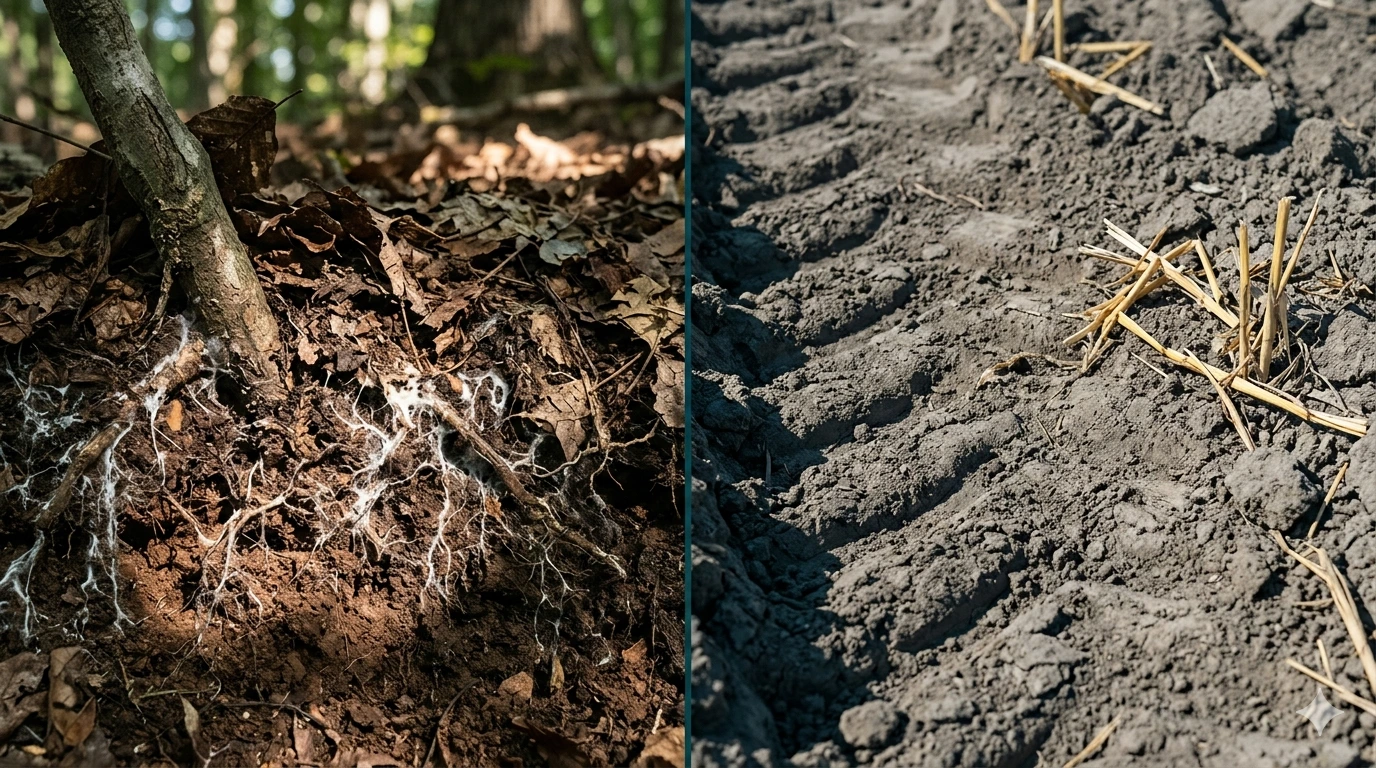
Walk into an old-growth forest and turn over a handful of soil. You will find a dense, white, cobweb-like mat running through the leaf litter. That is fungal mycelium, and it is the reason the forest does not need a fertiliser truck or a fungicide programme to stay healthy. Walk into a conventionally farmed orchard and dig the same hole. The soil will smell sour, look grey, and the mycelium will be gone.
That difference is not cosmetic. It is the single biggest reason your crop is vulnerable to pests, diseases and drought. The ratio of fungi to bacteria in your soil, what soil biologists call the F:B ratio, sets a hard ceiling on how high your plants can climb on the immunity ladder. Below a certain point, no foliar spray, no synthetic fertiliser, and no resistant variety can fully compensate.
This post explains what a fungally dominant soil is, why it matters for South African tree crops, and the specific stack of practices, including on-farm production of Liquid IMO and the use of cold-processed fish hydrolysate, that will shift your soil in two seasons.
What Is a Fungally Dominant Soil?
A fungally dominant soil is one where the biomass of beneficial fungi outweighs the biomass of bacteria. Soil biologists express this as the fungal-to-bacterial ratio, or F:B ratio. When the number is below 1, the soil is bacterial-dominated. When it climbs above 1, the soil moves into fungal dominance. Old-growth forests sit at F:B ratios of 100:1 or more. Most commercial South African agricultural soils sit at 0.1 to 0.3, the bacterial-dominant end of the spectrum.
Bacteria and fungi do different jobs underground. Bacteria are fast, simple and short-lived. They cycle volatile nutrients quickly, mostly as nitrate, and they thrive in disturbed, tilled, high-nitrogen environments. Fungi are slow, structural and long-lived. They build the physical scaffolding of the soil, mine recalcitrant minerals out of bedrock, and release nitrogen as ammonium, the form that woody perennials and high-value crops actually prefer.
Mycorrhizal fungi go further. Smith and Read (2008), in Mycorrhizal Symbiosis, document the symbiosis in detail: the fungus extends a network of hyphae far beyond the root zone, supplies the plant with phosphorus, zinc, copper, ammonium nitrogen and water, and receives plant-fixed carbon in return. Bacteria can do none of this.
What the F:B Ratio Tells You About Your Soil
The F:B ratio tells you which plant communities your soil is currently equipped to support. Dr Elaine Ingham, who pioneered the soil food web framework at Soil Foodweb Inc., has shown that different plant communities sit at different points on the F:B spectrum. The plant tells you what biology it needs. The biology tells you what plant the soil will support. When the two do not match, the farmer pays the difference in inputs.
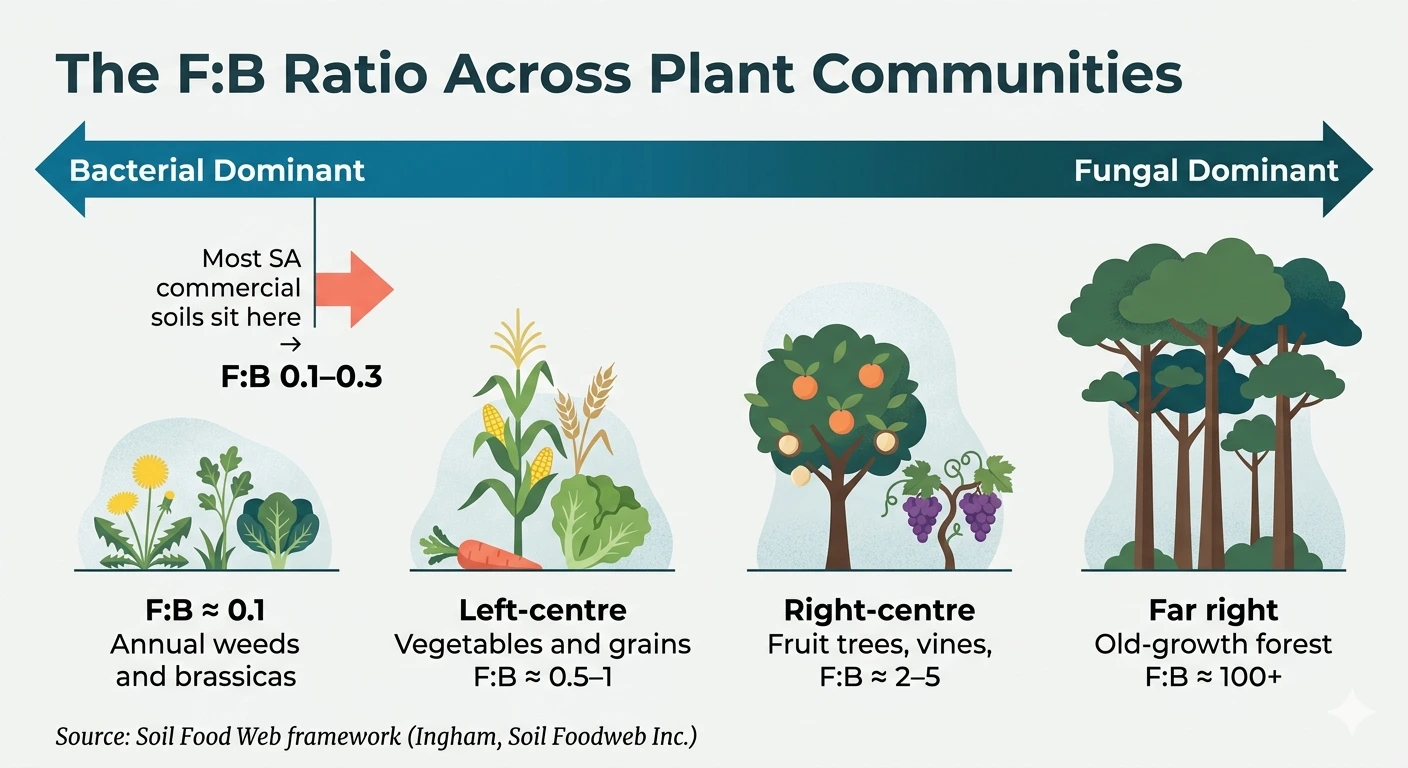
Annual weeds and brassicas dominate at F:B ratios well below 1, where bacteria run the show. Vegetables and grains sit around 0.5 to 1. Berries, vines and fruit trees climb toward 2:1 to 5:1. Mature forests run as high as 100:1 or more.
The implication for South African macadamia, avocado, citrus and vine producers is uncomfortable. Most of you are farming high-value perennials in soil that ecologically resembles a recently disturbed roadside verge. The result is exactly what we see across the industry. Chronic nutrient deficiencies. Falling Brix. Rising pest pressure. An ever-growing chemical input bill. None of it improves until the underlying soil biology shifts.
The Plant Health Pyramid Explained
The Plant Health Pyramid is a four-level framework, developed by John Kempf at Advancing Eco Agriculture, that links soil biology directly to a plant's pest and disease resistance. Each level the plant reaches unlocks a specific class of immunity.
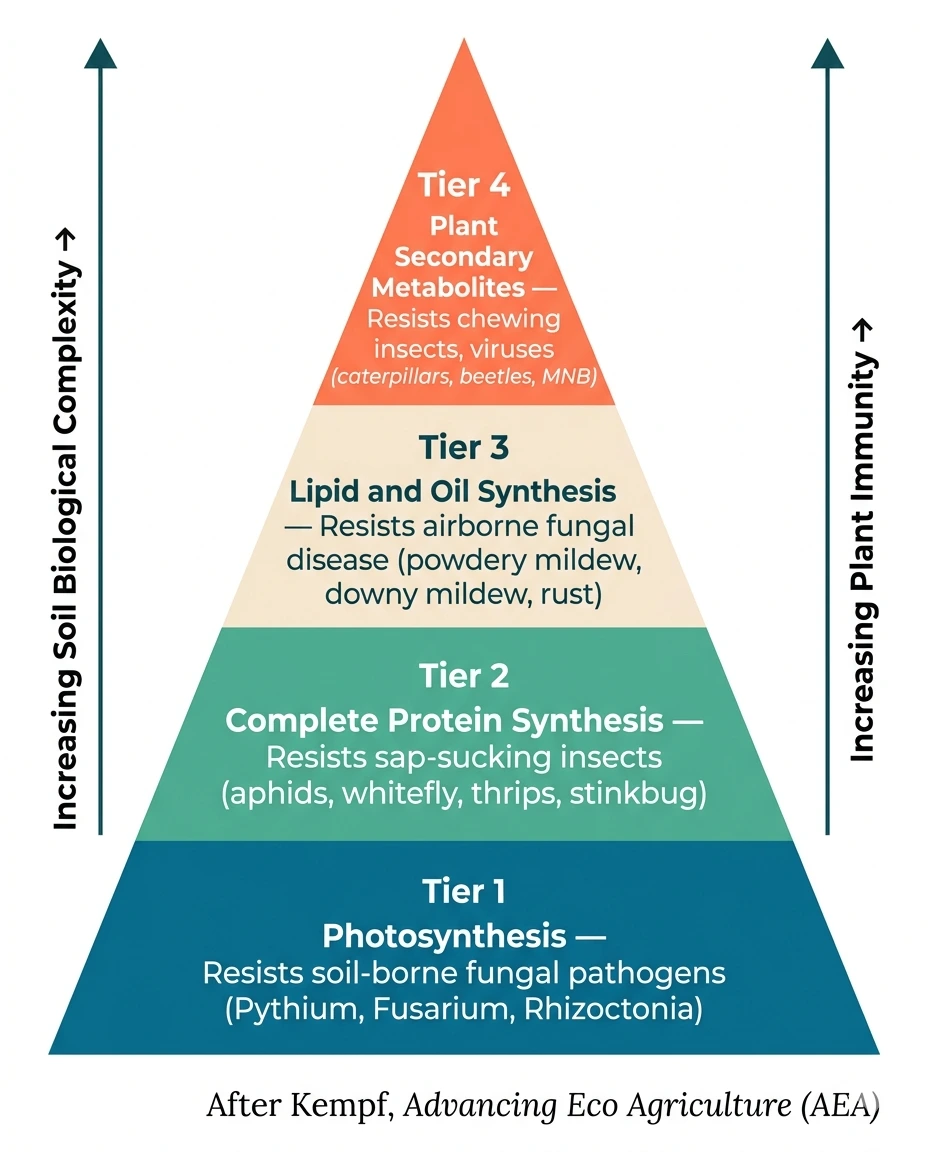
Level 1 is photosynthesis. A plant that is photosynthesising properly produces enough simple sugars to resist soil-borne fungal pathogens like Pythium, Fusarium and Rhizoctonia. Most commercial crops never operate above 30 percent of their photosynthetic potential, which is why root rots are so common.
Level 2 is complete protein synthesis. When the plant has enough sugars, plus enough trace minerals and microbial support, it converts soluble nitrate into complete amino acids and proteins. A plant operating at Level 2 stops being attractive to sap-sucking insects, the aphids, whitefly, thrips and stinkbug that feed on free amino acids and free nitrates in the leaf sap. They literally cannot digest a plant whose nitrogen is fully assembled into protein.
Level 3 is lipid and oil synthesis. Surplus sugars beyond what the plant needs for proteins get converted into plant lipids, the building blocks of strong cell walls and waxy leaf cuticles. A plant operating at Level 3 resists airborne fungal diseases, including powdery mildew, downy mildew, rust and botrytis. The cuticle is too tough for the spore to penetrate.
Level 4 is plant secondary metabolites. At the top of the pyramid, the plant produces terpenes, alkaloids, flavonoids and the full library of defensive compounds. A Level 4 plant is unattractive to chewing insects, including caterpillars, beetles and the macadamia nut borer. It also resists viral infection.
Here is the part most agronomists miss. The transition from Level 2 to Level 3, and especially the climb to Level 4, depends on the soil delivering a steady, balanced supply of trace minerals, ammonium nitrogen, and complex carbon compounds. Bacteria cannot deliver this. Only a fungal-dominant soil food web, with its mycorrhizal networks, saprophytic decomposers, and humic substance production, can sustain a crop at the top of the pyramid.
A bacterial-dominated soil traps the plant at Level 1 or Level 2, no matter what you spray on it. That is the agronomic reality the spray programme is hiding from you.
Why Bacterial-Dominant Soils Hold Your Crops Back
Bacterial-dominant soils hold crops back because they cannot supply the minerals, the form of nitrogen, or the structural carbon that high-value perennials need to climb past Level 2 of the Plant Health Pyramid. Decades of tillage, synthetic nitrogen, glyphosate and broad-spectrum fungicides have pushed nearly every commercial soil in the country in that direction.
Tillage physically shreds fungal hyphae. Bardgett and van der Putten (2014), in Nature, document the cumulative damage in their review of soil biodiversity and ecosystem function: each disturbance event sets the fungal community back by months. Synthetic nitrate fertiliser feeds bacteria preferentially and suppresses mycorrhizal colonisation. Fungicides kill fungi indiscriminately, including the beneficial ones. Glyphosate, beyond its herbicidal action, chelates manganese and zinc in the rhizosphere, further disrupting the mineral chemistry that fungi mediate.

Fungal hyphae physically bind soil aggregates with glomalin, mine recalcitrant minerals like phosphorus and zinc, and deliver them directly to plant roots. Bacteria cannot perform any of these functions.
The downstream consequences are predictable. Soil structure collapses because the glomalin produced by mycorrhizal fungi, the glue that binds soil aggregates, disappears. Wright and Upadhyaya (1996), publishing in Plant and Soil, first quantified just how much soil carbon is held up by glomalin alone. Water-holding capacity falls. Mineral availability narrows to whatever the bacteria can cycle, which is mainly nitrate and a handful of soluble nutrients. Recalcitrant minerals like phosphorus, calcium, silicon and the trace elements stay locked in the soil because the fungi that mine them are gone.
The plant responds by drawing harder on whatever is in the leaf sap, which means rising free nitrate and rising free amino acid concentrations. That is the chemical signature sap-sucking insects use to find their next meal. The plant has effectively turned itself into a beacon for pest pressure, not because it is weak in any genetic sense, but because the soil biology can no longer support its full metabolic chain.
Bacteria are not the villain. Every healthy soil has billions of them, and they are essential for nutrient cycling. The problem is the missing fungal counterweight, which is what shifts the soil from a weed-supporting environment to a crop-supporting one.
How to Increase Fungi in Your Soil
The F:B ratio is not fixed. Soil biology responds to management within a single season, and dramatic shifts are visible within twelve to twenty-four months when the right inputs are stacked correctly. The sequence below is the one we use on our own KwaZulu-Natal macadamia operation.
Stop the Bleeding First
Reduce or eliminate the practices that destroy fungi. Park the disc and the rotavator. Cut synthetic nitrate to a minimum, or replace it with foliar urea and biological inputs. Stop the calendar fungicide programme and move to a curative-only model based on monitoring. Every pass of a broad-spectrum fungicide is a setback of months for fungal recovery.
Stop Bare Soil
Fungal hyphae need a continuous food source, which comes from living plant roots exuding sugars into the rhizosphere. Bare soil means dead fungi within weeks. Cover crops, living mulches, inter-row vegetation and orchard understorey plantings keep the fungal network fed year-round. Diverse mixes, including grasses, legumes and brassicas, support different fungal guilds.
Build Solid Carbon on the Surface
Fungi feed on complex, lignin-rich materials that bacteria cannot easily digest. Wood chips, bark mulch, sugarcane bagasse and crop residues all favour fungal growth. In a macadamia orchard, leaving the husks and shells on the ground is one of the cheapest fungal-promotion strategies available. The carbon-to-nitrogen ratio of your surface mulch matters: aim for 30:1 or higher to favour fungi.
Inoculate with High-Quality Fungal Compost
A Johnson-Su bioreactor produces an exceptionally fungal-dominant compost. Dr David Johnson and colleagues, publishing in AIMS Agriculture and Food (2017), show F:B ratios above 10:1 in mature Johnson-Su compost, orders of magnitude higher than anything you can buy at a garden centre. A small volume of this material, applied at planting or as a slurry, seeds the orchard with the right biology.
Brew and Apply Liquid IMO (LIMO) On Farm
This is where Korean Natural Farming becomes a serious commercial tool. A properly engineered Liquid IMO extract, brewed on farm from solid IMO 3 compost on a substrate of sugarcane bagasse and maize bran, delivers a fungal-dominant biology in a form that fits modern fertigation and foliar spraying. The economics are compelling: once the IMO 3 base is established, a 1,000-litre brew costs almost nothing in inputs and replaces several thousand rands of off-the-shelf microbial product.
The key is what you feed the brew. Simple sugars like molasses produce a bacterial bloom. Complex foods like fish hydrolysate, humic acid and oat flour drive fungal dominance.
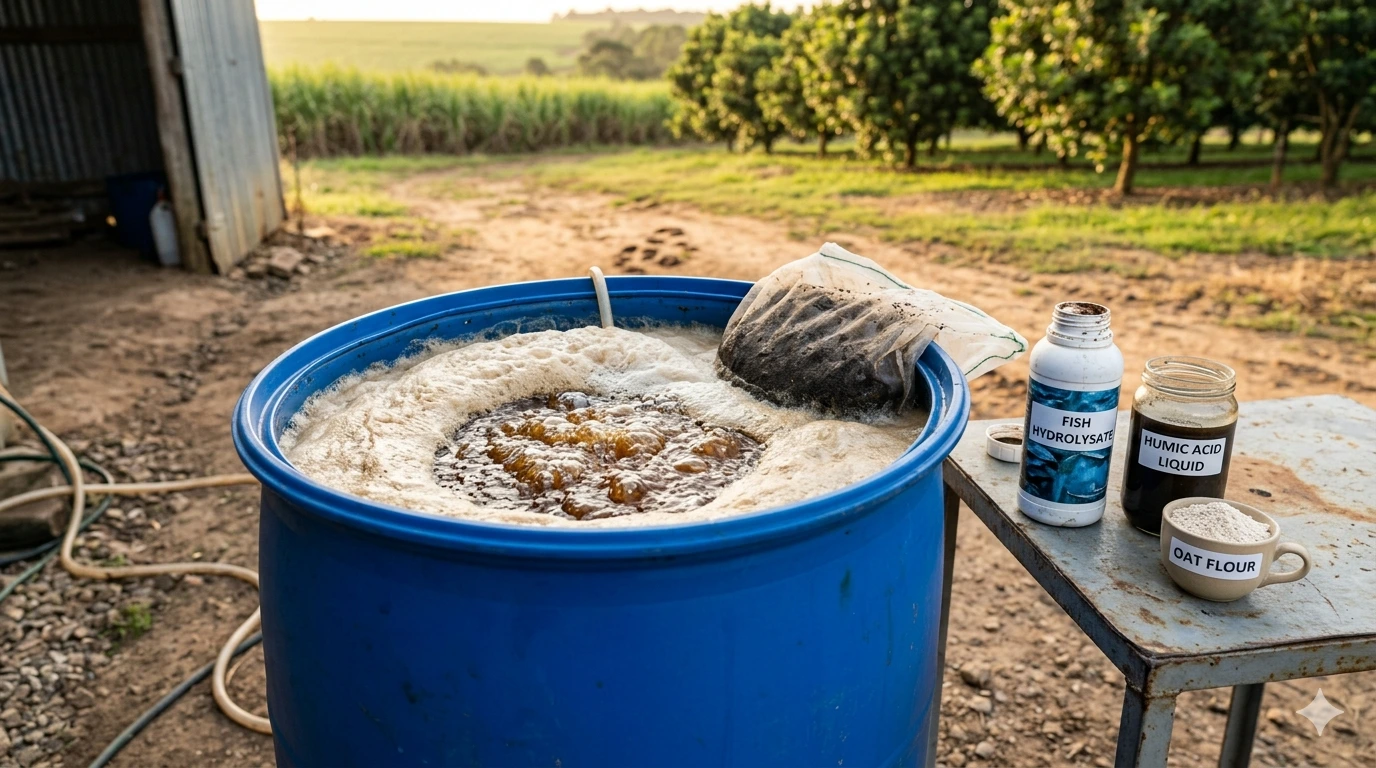
Apply LIMO at 1:500 to 1:1000 dilution as a soil drench, and at 1:200 to 1:500 as a foliar spray. Always apply in the late afternoon or on overcast days to protect the microbes from UV.
Feed the Fungi with Marine Lipids
Cold-processed fish hydrolysate is the single most effective fungal-promotion input available to commercial agriculture. The complex marine lipids and intact long-chain proteins are exactly what mycorrhizal and saprophytic fungi need to build their cell walls and synthesise ergosterol, the primary structural component of fungal membranes. Bacteria lack the lipase enzymes to compete for these foods in an aerated water column, which means fish hydrolysate acts as a selective biological pressure that favours the fungi you want.
This is not a small detail. The difference between a fish emulsion, which is heat-rendered and stripped of lipids, and a true cold-processed fish hydrolysate, which is enzymatically digested with the full lipid profile preserved, is the difference between feeding bacteria and feeding fungi. If you are buying fish input for your orchard, this is the spec line that actually matters. Read more on the science of LAB fermentation and cold biological processing here.
Common Questions
How do I know if my soil is fungally dominant?
The cheapest field check is to dig under a permanent mulch layer or a long-undisturbed perimeter strip and look for white, cobweb-like hyphae running through the litter. For a quantitative answer, send a soil sample to a soil food web laboratory for direct microscopy, or use a microBiometer test kit on the farm. Visible mycelium under your orchard mulch is a strong indicator that the F:B ratio is above 1.
How long does it take to shift soil from bacterial to fungal dominance?
Twelve to twenty-four months, when the interventions are stacked correctly. Visible structural change, darker soil, better aggregation and the return of earthworms typically appear within the first year. Measurable F:B ratio shifts toward 1 over a full season. Reaching 2:1 or higher, the level of tree crops demand generally takes two seasons of disciplined management. Skipping any single layer in the stack extends the timeline.
What is the difference between fish emulsion and fish hydrolysate?
Fish emulsion is heat-rendered. The high temperatures break down marine lipids and denature long-chain proteins, leaving a product that bacteria can digest but fungi cannot. Cold-processed fish hydrolysate is enzymatically or microbially digested at low temperature, preserving the lipids and intact proteins fungi need to build cell walls. For fungal-dominance work, only true cold-processed hydrolysate, such as a properly fermented fish silage, performs.
Can I shift my soil to fungal dominance without losing commercial yield?
Yes, when the transition is planned. Pulling all the synthetic nitrogen in a single season will cost yield. The realistic path is to taper synthetic inputs over two to three seasons while building the biological base underneath: cover crops, surface carbon, on-farm LIMO and cold-processed fish hydrolysate. Yield in the first transition year typically holds. By year two, you usually see Brix and shelf life improve before total yield does.
The Bottom Line
Plant immunity is not a spray decision. It is a soil biology decision, made years before the pest arrives. Crops trapped at Level 1 or Level 2 of the Plant Health Pyramid, in bacterial-dominated soils, will need a chemical crutch every season. Crops operating at Level 3 and Level 4, in fungal-dominant soils, defend themselves.
The F:B ratio is the simplest single number that tells you which side of that line your farm sits on. If your soil is below 1, you are farming against ecological succession, and the cost of that fight shows up on every line of your input bill. If you can lift it above 1, and ideally toward 2 or 3 for tree crops, the soil starts doing the work you have been paying spray contractors to do.
Shifting the ratio is a multi-year project, but it is not complicated. Stop tilling. Keep living roots in the ground year-round. Build solid carbon on the surface. Inoculate with fungal-dominant compost. Brew and apply your own Liquid IMO. Feed the system with cold-processed marine lipids, not sugar and synthetic nitrate. Within two seasons, the soil structure will change, the spray bill will start dropping, and your crop will begin climbing the Plant Health Pyramid on its own.
That is what regenerative agriculture actually delivers, when it is executed with the right biology. You can do this on the soil you are already standing on.
Is your soil truly alive? Fungal-dominant biology is the "internet of the soil," moving nutrients and water exactly where your crops need them most.
Oceanic Organics partners with you to restore these vital networks.
We provide:
- The Benchmark: A rigorous assessment featuring 14 on-farm tests.
- The Audit: Identifying the specific practices currently stalling your soil's potential.
- The Blueprint: A customised biological program built for your unique context.
Ready to grow smarter? Let's talk biology.
Key Sources: Ingham, E.R. Soil Food Web Approach (Soil Foodweb Inc.) • Kempf, J. The Plant Health Pyramid (Advancing Eco Agriculture) • Smith, S.E. and Read, D.J. (2008) Mycorrhizal Symbiosis, 3rd ed., Academic Press • Wright, S.F. and Upadhyaya, A. (1996) Plant and Soil 198(1):97-107 • Johnson, D.C. et al. (2017) AIMS Agriculture and Food 2(2):216-241 • Bardgett, R.D. and van der Putten, W.H. (2014) Nature 515(7528):505-511 • Lowenfels, J. and Lewis, W. (2010) Teaming with Microbes, Timber Press • Cho, H.K. Korean Natural Farming Handbook (Janong Natural Farming Institute)